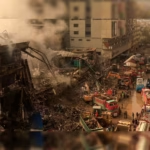

The reviews site has been keeping tabs on closures since March. Business can update their status to temporarily or permanently closed on Yelp. As of August 31, nearly 163,700 businesses on Yelp have closed since March 1, the company said, marking a 23% increase from July 10. Of those, about 98,000 say they’ve shut their doors for good.
Of all closed businesses, about 32,100 are restaurants, and close to 19,600, or about 61%, have closed permanently.
As the dust settles on the global economic landscape of 2026, a sobering reality has emerged from the wreckage of the pandemic era. What began as a “temporary” pause for millions of storefronts has solidified into a permanent restructuring of the global marketplace.
While the initial lockdowns were framed as a 15-day sprint to “slow the spread,” for more than half of the businesses that shuttered their doors during that pandemic period, the lights never came back on. This isn’t just a story of closed doors; it is a narrative of shifted wealth, altered consumer habits, and a fundamental change in the “DNA” of the modern business world.
The Great Shuttering: Why 60% of Pandemic Closures Became Permanent
Early in the crisis, organizations like Yelp and the JPMorgan Chase Institute began tracking the health of the business sector. The initial data was startling, but the long-term findings are even more profound. By late 2020, data indicated that nearly 60% of all closed businesses on major platforms would never reopen due to that pandemic.
The “Cash Buffer” Problem
The primary culprit wasn’t just a lack of customers; it was a lack of time. Most small businesses operate on razor-thin margins. According to the JPMorgan Chase Institute, the median small business had less than 27 days of cash buffer on hand before the pandemic. When the lockdowns stretched from weeks into months, that buffer evaporated.
The Debt Trap
Even those that managed to survive the initial waves often did so by taking on massive debt through various government loan programs. By 2022 and 2023, as interest rates rose to combat post-pandemic inflation, the cost of servicing that debt became the final nail in the coffin for businesses that were technically “open” but financially insolvent.
The Industries That Vanished
The impact was not distributed equally. While tech and logistics boomed, the “tactile economy”—businesses that rely on physical presence and human touch—faced an existential crisis.+1
1. The Restaurant and Nightlife Sector
Dining establishments faced a double-edged sword: high fixed costs (rent, utilities) and zero revenue. Even with the pivot to delivery, the 3–5% profit margins common in the industry couldn’t sustain the loss of liquor sales and dine-in traffic. Reports indicate that over 61% of closed restaurants are now permanent casualties.
2. Retail and the “Amazon Effect”
The pandemic didn’t create the shift to e-commerce; it accelerated a decade’s worth of transition into eighteen months. Local boutiques and specialized shops that lacked a digital footprint were the first to go. Those that remain today are often those that successfully integrated “omnichannel” sales strategies.
3. The Beauty and Fitness Industries
Gyms, yoga studios, and salons were among the last to be allowed to fully reopen. By the time they did, the “Peloton effect”—the shift toward home-based fitness and self-care—had permanently thinned out their memberships.
The “K-Shaped” Recovery: Winners and Losers
The phrase “K-shaped recovery” has become a staple of senior journalistic analysis in 2026. This describes an economy where one segment (the upward arm of the K) prospers while the other (the downward arm) continues to decline.
| Sector | Outcome in 2026 | Key Driver |
| Big Box Retail | Record Profits | Scale, logistics, and “essential” status. |
| Small Local Shops | Massive Closures | High rent, lack of digital infrastructure. |
| Tech/SaaS | Market Dominance | The shift to remote work and automation. |
| Hospitality | Consolidation | Chain hotels/restaurants replaced independents. |
The Concentration of Market Share
As small businesses vanished, market share didn’t disappear—it moved. Large corporations with deep pockets were able to weather the storm and subsequently “vacuum up” the demand left behind by the local “mom-and-pop” shops. This has led to a 2026 economy that is more concentrated and less diverse than the one we knew in 2019, during that pandemic period.
Why Reopening Became Impossible
For an entrepreneur, “reopening” isn’t as simple as turning a key. Several structural barriers made the return to business impossible for more than half of the shuttered firms, during that pandemic period.
- Supply Chain Fractures: Even as demand returned, the cost of inventory skyrocketed. A business that closed with $50,000 in inventory might have needed $80,000 to restock the same shelves two years later.
- The Labor Shortage: The “Great Resignation” saw millions of service workers leave the industry for better-paying, remote-capable roles. Small businesses, already struggling, could not compete with the rising wages offered by larger corporations.
- Real Estate Dynamics: In many urban centers, landlords remained firm on rent prices despite the lack of foot traffic. This led to a standoff that resulted in “For Lease” signs becoming a permanent fixture on many main streets.
The Social Impact: Beyond the Bottom Line
The loss of these businesses isn’t just an economic statistic; it’s a social wound. Small businesses are the “third places” of our society—locations that aren’t home or work where community is built.
“When a local bookstore or a neighborhood pub closes permanently, it’s not just a commercial failure. It’s the loss of a community hub, a sponsor for local little league teams, and a piece of a neighborhood’s identity.”
In 2026, we are seeing the rise of “commercial deserts” in lower-income areas where the density of small businesses has dropped significantly, leading to less local investment and fewer entry-level jobs.
Looking Forward: The 2026 Business Landscape
The businesses starting today look very different from those of 2019 during that pandemic period. The “New Normal” for 2026 start-ups involves:
- Asset-Light Models: Fewer physical storefronts and more mobile/digital services.
- Automation-First: Using AI and robotics to mitigate labor costs and shortages.
- Resilient Supply Chains: A focus on local sourcing to avoid global disruptions.
More updated and detailed: COVID-19_Pandemic in 2019
FAQ: Understanding Business Legacy
1. Why did so many businesses close permanently instead of temporarily?
The primary reason was the duration of the crisis. Most small businesses were built to survive a 2-week or 1-month disruption. When the pandemic effects lasted for years (through various waves and economic aftershocks), their capital and credit were exhausted.
2. Which industries were hit the hardest?
Restaurants, bars, retail, and personal services (gyms and salons) saw the highest rates of permanent closure, often exceeding 50–60% during that pandemic period.
3. Did government aid like the PPP help?
While the Paycheck Protection Program (PPP) and similar global initiatives saved millions of jobs in the short term, they were often insufficient for businesses with high fixed costs or those in industries that faced prolonged legal restrictions.
4. Are new businesses opening to replace the old ones?
Yes, entrepreneurship is actually at a record high in 2026. However, these new businesses are often digital-first or “side hustles” rather than the traditional brick-and-mortar establishments that were lost.
5. What is the long-term effect on consumers?
Consumers now face less choice and higher prices due to market concentration. However, they also benefit from more advanced digital services and delivery options that became standard during the pandemic.
The “Great Shuttering” of the 2020s will likely be studied by economists for decades. While the economy of 2026 has found its footing, the absence of those millions of small businesses serves as a reminder of the true cost of a global catastrophe—a cost measured not just in dollars, but in the lost dreams of entrepreneurs and the changing face of our communities.
Would you like me to analyse the specific impact of these closures on a particular region or city to narrow down the data? Send Email: info@thetimesofpakistan.com
People also want to read about:
Table of Contents
Last modified: February 13, 2026