
A Milestone in Pakistan’s Anti‑Corruption Perception
In early 2026, Pakistan’s ranking in Transparency International released the Corruption Perceptions Index (CPI) 2025, showing that Pakistan’s ranking and score improved compared with the previous year — a sign of encouraging, if modest, progress in how public sector corruption is viewed globally. The CPI 2025 placed Pakistan at 136th out of 182 countries, with a score of 28, up one point from its 2024 score of 27.
While this improvement is not dramatic, it signals shifts in perceptions of governance, institutional integrity, and anti‑corruption efforts. In this comprehensive analysis, we’ll explore what the CPI measures, how Pakistan’s score has evolved over time, factors behind the recent improvement, and why this matters for the country’s future.
Understanding the Corruption Perceptions Index (CPI)
The Corruption Perceptions Index is one of the most widely cited international indicators of public sector corruption. Published annually by Transparency International, a Berlin‑based global anti‑corruption NGO, the CPI scores and ranks countries based on perceived levels of corruption in public institutions such as the executive, legislature, and judiciary.
How the CPI Works
- Score Range: 0–100 (0 = highly corrupt, 100 = very clean)
- Rank: Position among all countries surveyed
- Data Sources: The CPI compiles assessments from multiple expert sources, such as business surveys and governance indicators.
- Focus: Perceptions of corruption in the public sector
- Purpose: Provide comparative insights into integrity, transparency, and accountability across countries.
The CPI does not measure actual corruption numerically; instead, it reflects expert and business perceptions — a valuable, though imperfect, proxy for governance quality.
Pakistan’s CPI 2025 Results: What Changed?
Basic Figures (2025)
- Global Rank: 136th out of 182 countries
- CPI Score: 28 out of 100
- Change from 2024: Up one point (from 27)
- Change in Countries Covered: From 180 (2024) to 182 (2025)
This improvement in score and slight adjustment in ranking indicate a marginally better perception of public sector corruption compared to the previous year. Importantly, the CPI’s expanded country list (more nations included in 2025) means direct comparisons to 2024 require contextual interpretation, because rank can shift due to more entries, not just internal performance.
Historical Context: Pakistan’s CPI Trajectory
To fully understand the 2025 improvement, it helps to look at Pakistan’s CPI performance over recent years:
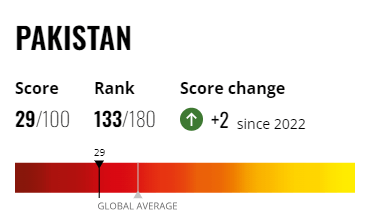
- In 2023, Pakistan scored 29/100 and ranked 133rd out of 180 countries.
- In 2024, the score declined to 27/100, and the rank shifted to 135th.
- In 2025, the score improved slightly to 28/100 and the rank became 136th out of 182 countries.
Although Pakistan remains in the lower half of global rankings, the recent uptick suggests that small shifts in governance, enforcement, or institutional reforms can influence international perception.
Why Pakistan’s Ranking Matters
1. Signal to Investors and Businesses
A country’s CPI score is often referenced by investors assessing political risks and governance quality. A higher score, even marginally, may help attract foreign direct investment by signaling improvements in institutional integrity and transparency. This is particularly relevant for sectors like infrastructure, energy, and finance where governance concerns influence investment flows.
2. Government and Policy Assessment
Governments use CPI outcomes to benchmark their anti‑corruption performance and reform effectiveness. A score increase suggests that, at least in experts’ perceptions, initiatives and reforms are having some impact.
3. Public Trust and Accountability
Perception of corruption influences citizen trust in government. Even a small improvement in CPI could contribute to stronger public confidence, if the reasons behind the score change are communicated and understood.
What Factors Contributed to the Score Increase?
According to Transparency International Pakistan’s analysis, several ongoing efforts may be contributing to the improved perception:
1. Governance and Institutional Reforms
Justice (retired) Zia Perwez, chair ofPakistan’s ranking in Transparency International, emphasized that governance reforms and improvements in some public institutions helped Pakistan’s CPI score climb. Continued implementation of recommendations from the IMF’s Governance and Corruption Diagnostic Assessment was also highlighted as critical to sustaining progress.
These reforms likely touch on:
- Strengthening accountability and oversight
- Improved transparency in legislative and executive actions
- Reducing administrative corruption in key institutions
2. Expanded Survey Coverage
The CPI’s expansion from 180 to 182 countries means more comparative data points. Expansion can influence ranking even when absolute scores change modestly.
3. Sectoral Progress
Some reports suggest that perceived corruption in specific areas, such as bureaucratic inefficiency or judicial misconduct, showed relative improvement in 2025, even if other aspects like enforcement lag.
However, it’s important to note that not all indicators improved. Some data sources used by Transparency International actually showed declines — for example in business perceptions of bribery and public fund misuse — indicating a nuanced picture.
Regional and Global Comparison
Looking beyond Pakistan offers useful context:
- India, a neighboring and regional comparator, ranked 91st out of 182 countries with a score of 39 in CPI 2025.
- The global landscape shows that over two‑thirds of countries scored below 50, reflecting widespread corruption perceptions worldwide.
- Countries at the top of the index, like Denmark, consistently score well (Denmark scored 89 in 2025), highlighting significant differences in governance systems and anti‑corruption mechanisms.
These comparisons help contextualize Pakistan’s position relative to regional peers and global norms.
Limitations of the CPI: Understanding Perceptions vs. Reality
1. Focus on Perceptions
It’s key to remember that the CPI measures perceived corruption, not corruption itself. The index is based on expert surveys and business sentiment, which can be influenced by media coverage, political rhetoric, and economic perceptions.
2. Data Source Variability
The CPI aggregates several independent sources. In 2025, some sources reported improvement, while others reported declines, resulting in a mixed overall picture.
This means that while perceptions may improve slightly, actual enforcement of anti‑corruption laws and institutional capacity to prosecute corruption can lag behind.
Public and Expert Reactions
Commentators and analysts are cautious but optimistic about Pakistan’s slight improvement in the CPI:
- Some note that incremental gains in perceived transparency can spur further reforms if sustained and expanded.
- Others warn that without systemic changes — in areas like judicial independence, public sector accountability, and civil service transparency — improvements may plateau.
Justice Zia Perwez and others have reiterated that broader governance reforms — including full implementation of IMF recommendations — are necessary to see more meaningful and sustained progress.
Challenges Still Facing Pakistan
1. Enforcement and Rule of Law
While some indicators show improvement, enforcement scores — such as those measuring how consistently corruption cases are prosecuted — remain weak.
2. Business Environment Perceptions
Business executives surveyed by the World Economic Forum reported a slight decline in Pakistan’s score regarding bribery and unfair practices, suggesting ongoing challenges in the business climate.
3. Institutional Confidence
Public confidence in institutions like the judiciary and law enforcement continues to lag, as reflected in specialized sub‑indices.
4. Global Corruption Trends
Transparency International noted that corruption is worsening globally, even in established democracies. This trend means Pakistan’s gains are not necessarily unique but part of a broader shifting landscape.
How Improved CPI Ranking Can Impact Pakistan’s Future
1. Economic and Investment Outlook
A better CPI score — even modest — may help Pakistan attract foreign investment by signaling a commitment to transparency. Investors often consult indexes like the CPI when evaluating risk.
2. Governance Reforms and Public Trust
Improved perceptions can encourage political and administrative leaders to continue implementing reforms, potentially enhancing public trust in institutions.
3. International Diplomacy and Aid
Higher CPI scores may improve Pakistan’s international reputation, making it easier to negotiate trade deals, aid packages, and international cooperation on governance issues.
Looking Forward: What Pakistan Needs to Sustain Progress
Experts and civil society advocates recommend several priority areas:
1. Strengthen Anti‑Corruption Enforcement
Pakistan must bolster institutions like the National Accountability Bureau (NAB) and ensure judicial independence to prosecute corruption cases impartially.
2. Increase Transparency in Public Spending
Open data on government contracts, procurement, and political financing can reduce opportunities for corruption.
3. Support Civil Society and Media Freedom
Free press and civic engagement are vital for uncovering corruption and holding public officials accountable.
4. Implement IMF Governance Recommendations
Full and timely implementation of IMF governance assessment recommendations could drive more significant improvements in future CPI reports.
Conclusion
A Step Forward, But the Journey Continues
Pakistan’s ranking in Transparency International modestly in 2025, with its CPI score rising to 28 and its global position advancing to 136th out of 182 countries. This improvement reflects some progress in perceptions of governance reform and institutional accountability, even as real challenges persist in enforcement, business climate, and public confidence.
While the improvement is modest, it sends a positive signal that ongoing reforms and increased focus on transparency can eventually yield more significant gains. Sustained effort, broad systemic changes, and stronger rule of law will be crucial if Pakistan hopes to continue climbing this important global index.
Corruption perception indexes like the CPI are not simply statistics — they influence economic decisions, public trust, and international relationships. In Pakistan’s case, a rising CPI score may be an early indicator that reforms are beginning to take root. The challenge now lies in turning perceptions into measurable, long‑lasting institutional integrity.